Inside the Clashes at Delaney Hall Detention Center
:A Timeline from a Mutual Aid Volunteer


On May 22, 2026, amid a surge of hunger strikes in immigration detention prisons across the United States, 300 detainees announced from their cells in Newark, New Jersey that they would not eat and would not toil for their captors until their demands were met. This sparked ten days of protest and furious retaliation from federal, state, and local authorities. What began as a peaceful vigil outside Delaney Hall Detention Center in solidarity with the hunger strikers ended with New Jersey State Troopers encircling, brutalizing, and arresting scores of people.
The series of events leading up to the strike and culminating in a marathon of violence has been densely packed. Consequently, the fog of war has obscured key details, including the complex dynamics at play between protesters and mutual aid workers, between experienced anti-ICE activists and the local terrain, between the government of New Jersey and federal mercenaries. Here, a participant in mutual aid efforts at Delaney Hall over the preceding months—who was on the ground for much of this wave of protests—recounts how the clashes unfolded.
You can donate to support families impacted by immigrant detention here.
Who, What, When, Where
I am a volunteer with Eyes on ICE New Jersey, a mutual aid collective that has been providing aid and hospitality to the detainees held captive in Delaney Hall—which is one of the largest Immigration and Customs Enforcement detention centers in the Northeast—and to the families that travel to visit them.
Eyes on ICE is a coalition of volunteers and a preexisting network of aid organizations, including Movimiento Cosecha, Pax Christi New Jersey, First Friends of New York and New Jersey, Mami Chelo Foundation, and others that have emerged over decades of advocating for those subjected to an increasingly archaic immigration system. Established immigrant justice and faith-based communities with aligned advocacy goals converged on Delaney Hall soon after it reopened in May 2025. Despite the forceful retaliation of federal and local police, the protests continued, only slowing down after the arrests of faith leaders and Newark Mayor Ras Baraka.
Over the following weeks, protesters self-organized and refocused their efforts—shifting to assisting detainees and their families through networks of aid distribution, lawyers, and advocates, seeking to catch people before they fall through the cracks. At the same time that the aid group was being built, a ring of concertina-topped mesh-fencing sprang up around the prison. As the weather grew colder, the government of Essex County, the county that holds the detention facility, erected a permanent white tent to house Eyes on ICE. That tent has come to be called the “Radical Hospitality Zone.”
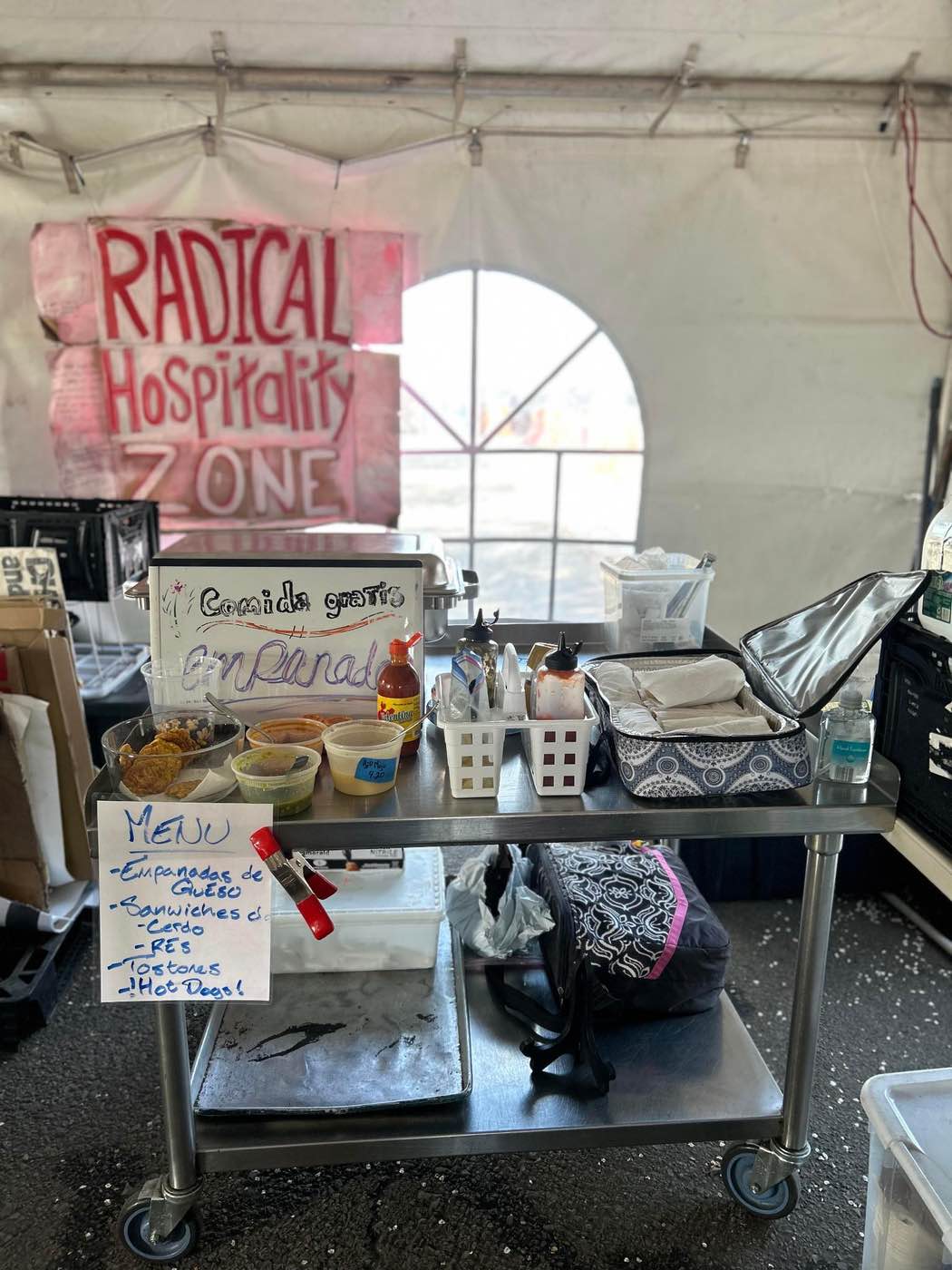
The “Radical Hospitality Zone,” where Eyes on ICE volunteers built a space for visitors coming to see people incarcerated in Delaney Hall.
Volunteers who do not have professional careers in advocacy participate by helping to maintain a community at the prison gates. Some of us cook or battle inclement weather. Others offer child care, collect donations of groceries and diapers, assist visiting families with transportation, or beautify the tent that houses us with art and music. All of us work together to document the detainees and their captors.
Delaney Hall Detention Center is situated in one of the busiest shipping hubs in the country. Located directly behind Newark Airport, the private prison shares the same square mile with multiple incineration plants and a busy commercial road. Periodically, a train screams by loaded with trash to be incinerated or animal carcasses for reprocessing at the facility across the street. The prison is about the size of a Costco, with a 1000-bed capacity. It is operated by GEO Group, one of the largest private prison contractors in the world. GEO Group has a poor human rights track record and is quick to dismiss any inquiries or criticisms.
The New Jersey Globe reports that the prison is often at maximum capacity; volunteers do their best to count the number of captives inside the tinted windows of the vans that come and go. Some of the people who are released tell us they were arrested just days earlier, usually by accident or as a consequence of racial profiling. Others have been in the system for months,
“…transferring between detention centers in Louisiana, Texas, and then back to Delaney, seemingly with the dual purpose of keeping them hidden or underrepresented in the legal system, while also creating excuses for GEO Group (owner of Delaney and often the largest private prison company in the states) to run up quite the tab with the obsequious federal government.”
The facility is built on a filled-in portion of marshland and river. Backfill and debris from old construction form the foundation for Delaney Hall and the rest of the Ironbound neighborhood. The Ironbound is a historically redlined neighborhood, meaning it has long been home to Black, brown, and immigrant communities. Consequently, the Ironbound was zoned for heavy industry, and the 16-mile stretch of land that Delaney Hall sits on has come to be known as “Chemical Corridor” due to rampant environmental contamination from every form of industry imaginable.
In short, it is desolate. There are no homes nearby and a single bus line serves the area. This was the arena for the week of state violence that shook the country.
Behind the Strike
On May 22, Gabriela Soto, whose husband Martin Soto was then held in Delaney Hall, announced that a protest had begun within the prison. During the early hours of the protest, she publicly shared a phone call with Martin. The privilege of speaking on the phone with detainees has since been revoked for all families, along with all other forms of visitation. During that call, Martin announced that he had coordinated with up to 300 other detainees to begin a hunger and labor strike to draw attention to inhumane living conditions and lack of due process under the law.
Detainees in Delaney Hall are forced to do all the work to maintain their own prison, receiving $1 per day in return; they regularly report receiving extremely poor quality food, including spoiled food. There are also consistent reports of mistreatment, unsafe living conditions, medical neglect, and sexual assault. Navigating the legal procedures around their detention is difficult; at best, these are intentionally opaque.
Starting months before the strike began, Eyes on ICE volunteers and participating organizations received a series of handwritten letters from detainees. In March, a letter arrived captioned with a large “S.O.S.” and undersigned by 300 detainees from across various cell units. They detailed horrendous conditions, rapid transfers and deportation hearings, and other forms of torture. Many called specific judges out by name for their cruelty.
The strikers demanded that New Jersey governor Mikie Sherrill come to Delaney Hall to meet with them and witness the conditions in the prison. They also called for the very young, very old, and medically infirm be released from the prison; an end to coercive pressure to sign voluntary deportation papers; and a meaningful review of cases and habeas corpus filings.
Gabriela Soto’s announcement precipitated a coordinated call for all Eyes on ICE volunteers and their communities to participate in a 24/7 vigil in solidarity with the strikers.
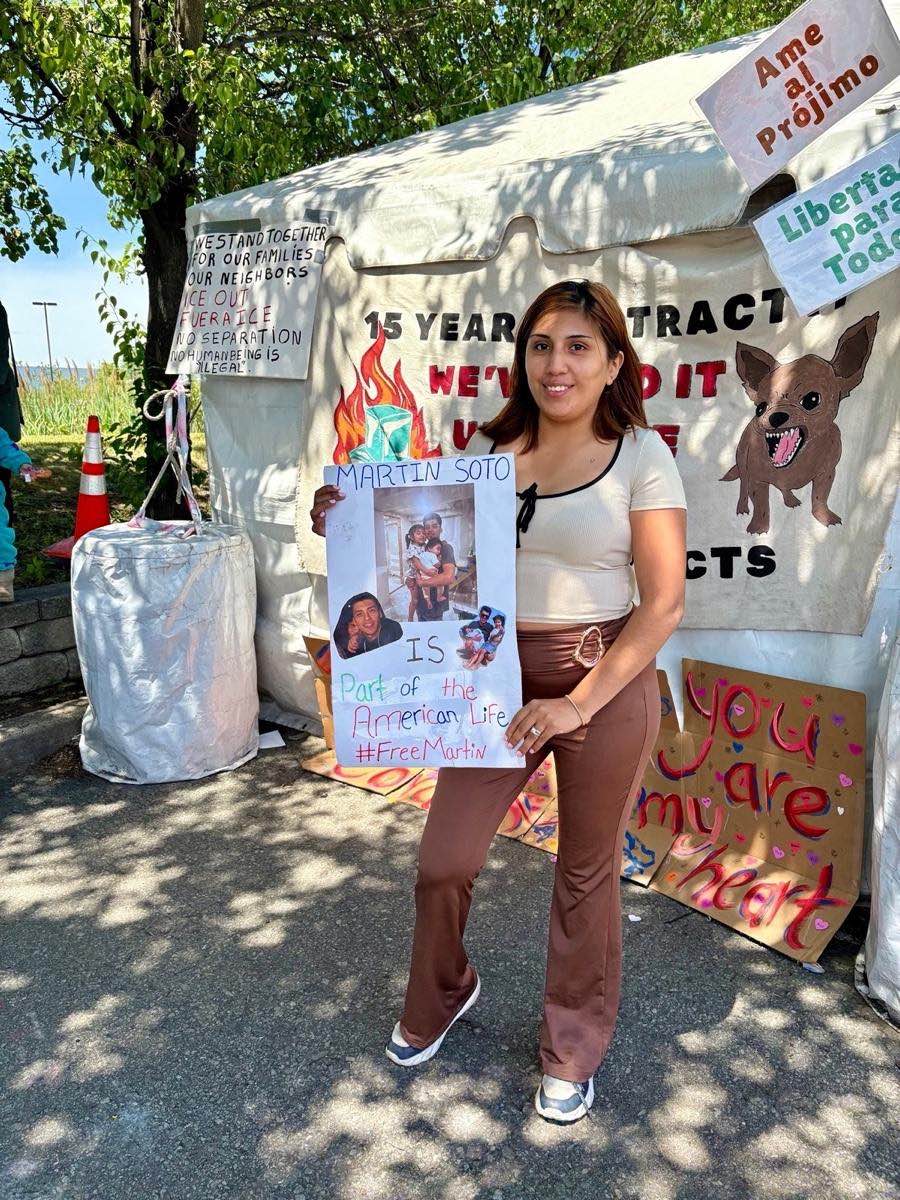
May 22, 2026: the hospitality tent outside Delaney Hall. Gabriela Soto holds a sign she made with her family as she announces the hunger strike.
The Vigil
That vigil began immediately after Gaby made her announcement at noon on May 22. At 2 pm, family members of the detainees who were on strike reported that they were unable to communicate with their loved ones. The detainees typically had access to tablets that could make video calls, but the prison guards had revoked the communication privileges of the units that were on strike in retaliation. This information was confirmed by a person detained in the striking unit 2a/b. About to be deported, he used his final phone time to validate this detail. While other detainees in other units had agreed to the strike, 2a/b was the unit Martin Soto was held in, the unit that had initially announced the strike.
By 6 pm, the number of protesters at the vigil had swelled to between thirty and forty people. There were several local media vans on scene. The story garnered a brief mention in the evening news in relation to the other strikes across the country.
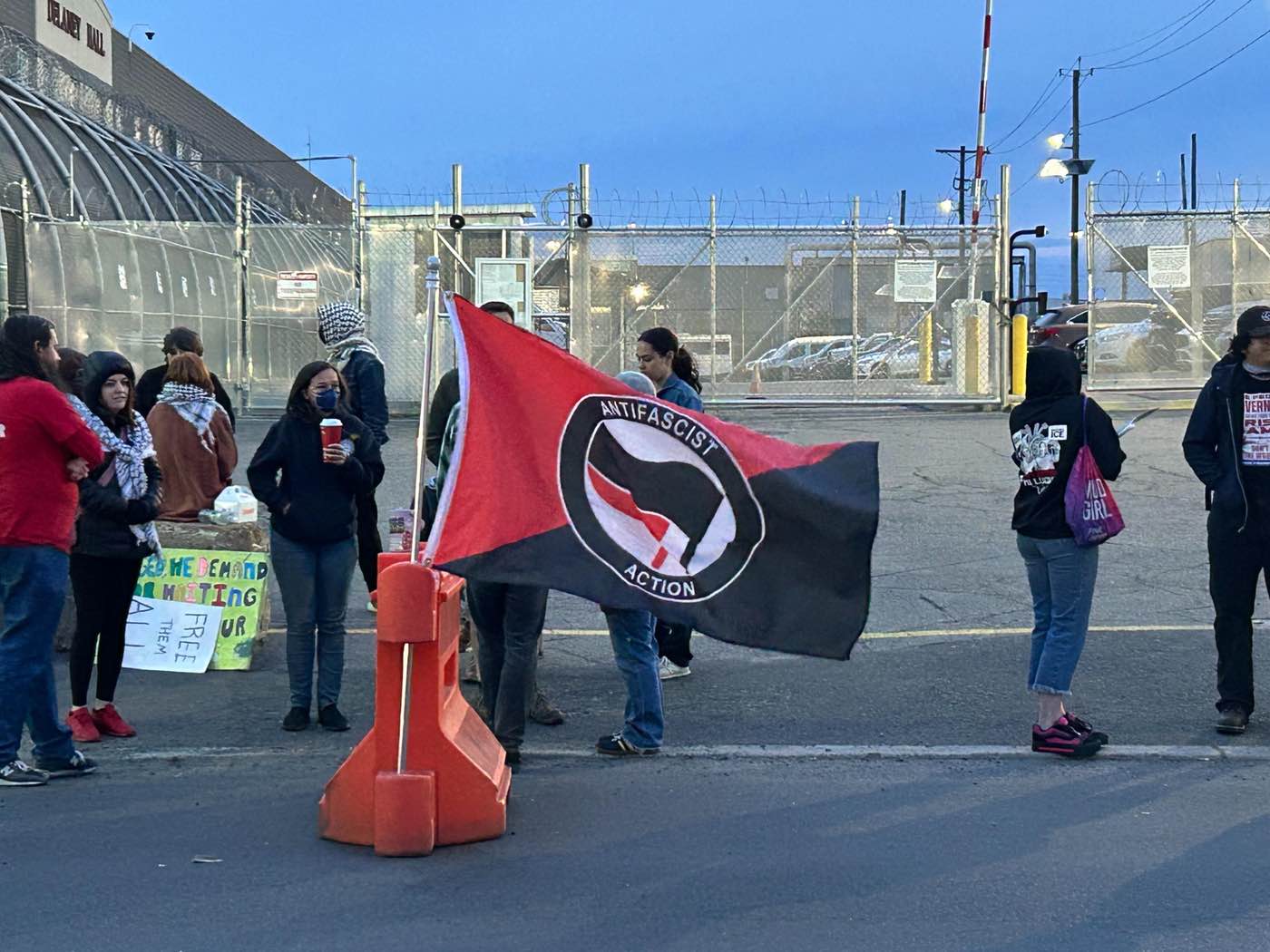
Outside Delaney Hall on the evening of Friday, May 22.
As protesters chanted and sang into the night, detainees could be seen silhouetted in the windows closest to the street—waving, dancing, and placing heart-shaped cutouts against the opaque glass. Their response drove home that the vigil was cutting through their isolation.
As the evening went on, a few detainees were released, as usual, one or two at a time, often as a consequence of paying bail. The volunteers carried out their intake process and made sure they were safe and had access to transportation and legal advice.
The protest lasted through the night and into the following days without incident. Guards and protesters exchanged insults, but neither side deployed anything stronger.
On Saturday, May 23, Gaby shared that her husband Martin, now seen as the primary instigator of the strike, had been offered release if he would call off the strike. According to Gaby, he said, “I don’t want to talk, put me back into my cell.”
The alarm system for the building was set off for the day and night, a tactic that Eyes on ICE volunteers have witnessed as a means of psychologically torturing the detainees. The alarm is about the volume of a fire alarm in most high schools, but left on for the entire day and night to prevent sleep.
Though guards initially denied him entry, Senator Andy Kim was eventually able to enter the facility. He spent several hours inside, speaking to dozens of detainees. In a speech he made afterwards, joined by Representative Rob Menendez, Kim confirmed most of the claims of the strikers, including the poor food and water quality, unacceptable sanitary conditions, and reports of mistreatment and medical neglect.
Opening Salvo
Another night passed without incident as the protesters maintained a continuous presence. On Saturdays and Sundays, the facility is open for visitation and families are allowed in. Families continued to come for regular visitation throughout the weekend, bringing children and elders. This gave a familial air to the protest, with children chalking on the driveway leading to the gates and sometimes leading chants.
On Saturday evening, Martin’s cell mates reported that ICE agents or guards came to the room to remove Martin to solitary confinement. Each twenty to thirty or more people inside. All thirty of Martin’s cellmates grouped around him and locked arms, refusing to let him be punished for his role in the strike.
At about 4 pm on Sunday, May 24, Gaby approached the prison for a scheduled visit with Martin. Once she was inside the fence but had not entered the facility itself, she saw two ICE agents physically carry her husband out of the prison and throw him into the back of one of the white vans used for detainee transfer. Later, when she was eventually permitted to talk with him, she discovered that guards had lured him into leaving his cell by reassuring him that he was going to be released. He followed them to a second room, where ICE officials attempted to interrogate him, then prepared him for transfer and tossed him into a van.
A call went out to Eyes on ICE volunteers and to various other leftist and aid groups as far afield as New York and Pennsylvania. Because Delaney Hall receives detainees from a large area, this was not just New Jersey’s fight. The message of Eyes on ICE was simple: “They’re retaliating against the strikers, and we won’t let them disappear even a single one until their demands are heard.”
Elected officials who had been planning a congressional oversight visit that week were notified. The US representative for New Jersey, Rob Menendez, arrived later that night for an unannounced visit. He had visited a week prior but had left with the impression that the prison had been prepared in expectation of his inspection. Menendez was allowed into the gates of the prison, but was barred from entry for fourteen hours while a cleaning crew came to dispose of whatever they did not want him to see. He remained in the courtyard in the rain that whole night, trying to check vehicles for transfers and relaying information to protesters outside the gate.
The blocking action started immediately with the legal protection of a federal judge’s court order—put in place pending the review of a previously filed Habeas petition barring Martin’s removal from the facility. With the blocking action in place, protesters formed a barrier from orange plastic water tanks commonly used as construction barriers. About 150 protesters stood behind the barrier by 8 pm on Sunday night.
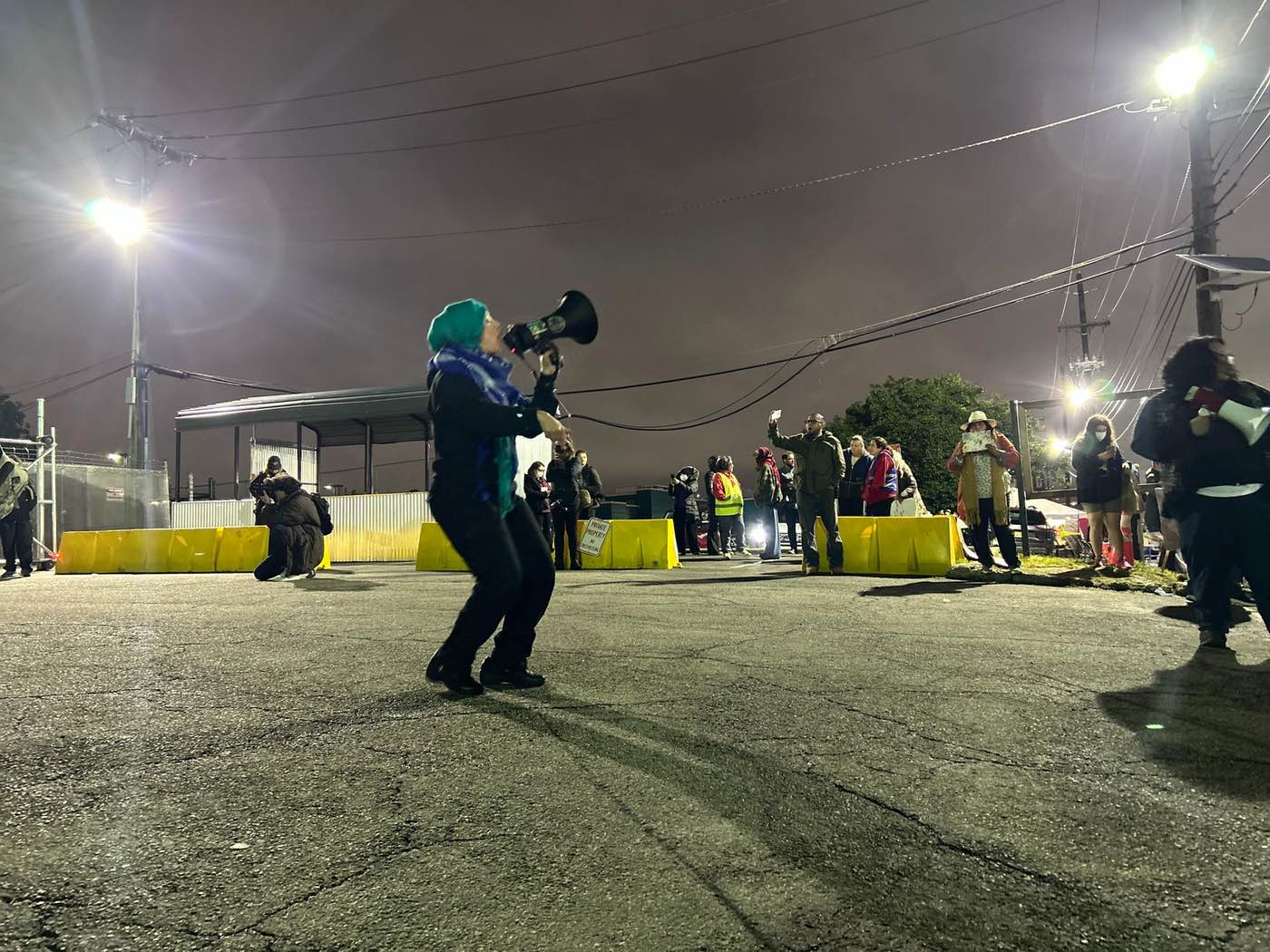
Outside Delaney Hall on the evening of May 24.
As the night wore on, the crowd thinned to about 75 people, but they successfully stopped each attempted transfer from the facility. Eyes on ICE volunteers attempted to persuade the crowd to respect the property boundaries and refrain from physically obstructing the personal vehicles of GEO Group employees. Newark Police were dispatched several times to escort the transport vans past the crowd; people clearly and calmly explained to them that they were participating in an illegal removal. They disengaged at about 11 pm.
Spirits were high, but several protesters argued over tactics. Many did not understand why volunteers asked that GEO Group vehicles be allowed to leave. The crowd did their best to inspect non-transport vehicles as they exited, but some protesters wanted to limit all vehicle movement in and out. Volunteers with Eyes on ICE repeatedly explained their reasoning for not wanting to engage with the police. Many volunteers had been present for the previous year’s protests at the facilities’ opening and did not want a repeat incident.
At several points, GEO employees lurched their vehicles through the crowd, hitting people and almost pinning one against a barrier.
At 1:30 am that night, a light rain began to fall. Protesters were formed in two groups, one by the main gate composed of between forty and fifty protesters and a smaller group of about ten by a secondary unused gate a hundred yards to the south, called gate five. It had been almost two hours since the agents attempted any transports, and the energy of the protesters was settling for a night’s vigil.
Suddenly, approximately twenty ICE agents stormed from the south gate, armed with pepper spray. They shoved through the newly assembled barriers and sprayed several people in the smaller group of sentries. The ICE agents grabbed those who attempted to defend the barrier and threw them to the ground. One woman in her sixties remained at the barrier; three agents shoved her to the ground, picked her up, and threw her back down with considerable force about ten feet away. She was taken to the University Hospital about an hour later for broken ribs and trouble breathing.
As soon as they had cleared a pathway, a convoy of ten unmarked vehicles, mostly Jeep compasses, sped out of the facility headed north toward downtown Newark. Later, a suspicion was confirmed that one of the vehicles carried Martin Soto, illegally transporting him to Elizabeth detention center—a smaller ICE facility.
Once the vehicle carrying Martin and an escort vehicle were clear of the main body of protesters, the remaining eight cars turned around in the entrance of the Essex County Corrections Facility, a medium-security state prison right next to Delaney Hall. The feds sped recklessly through the protesters on the street, narrowly missing several. They stopped their cars in a line directly in front of the south gate and deployed from their vehicles, one to two agents emerging from each car. Most agents were armed with telescoping batons, and about five carried large cans of pepper spray (likely MK 38, supplied by Safariland).
The protesters at the north gate began responding to the ICE agents. Gaby was taken into the hospitality tent and instructed not to leave, as she was four months pregnant. Some protesters stayed behind at the north gate to ensure that the agents were not acting as a decoy. The rest rushed south. Just as they arrived to find that the crew at the south gate had been beaten and sprayed, the agents resumed spraying. However, the parallel parked vehicles on the street partially screened the protesters, and a truck returning from the port with a large shipping container in tow was stopped, further blocking the spray.
Some protesters and independent photographers ran into the street to confront or photograph the agents. They were sprayed and chased back to the sidewalk, where agents hit several people with batons and sprayed several more at point-blank range. The entire encounter lasted about three minutes from the ICE agents exiting the gate to the moment they returned to their vehicles and sped south for the night.
The pepper spray had severe effects, as most of the protesters that evening lacked adequate PPE.
Representative Menendez maintained that he did not see the agents move Martin from the back of the van that he was believed to be in, but Menendez did not claim to have been watching it the whole time.
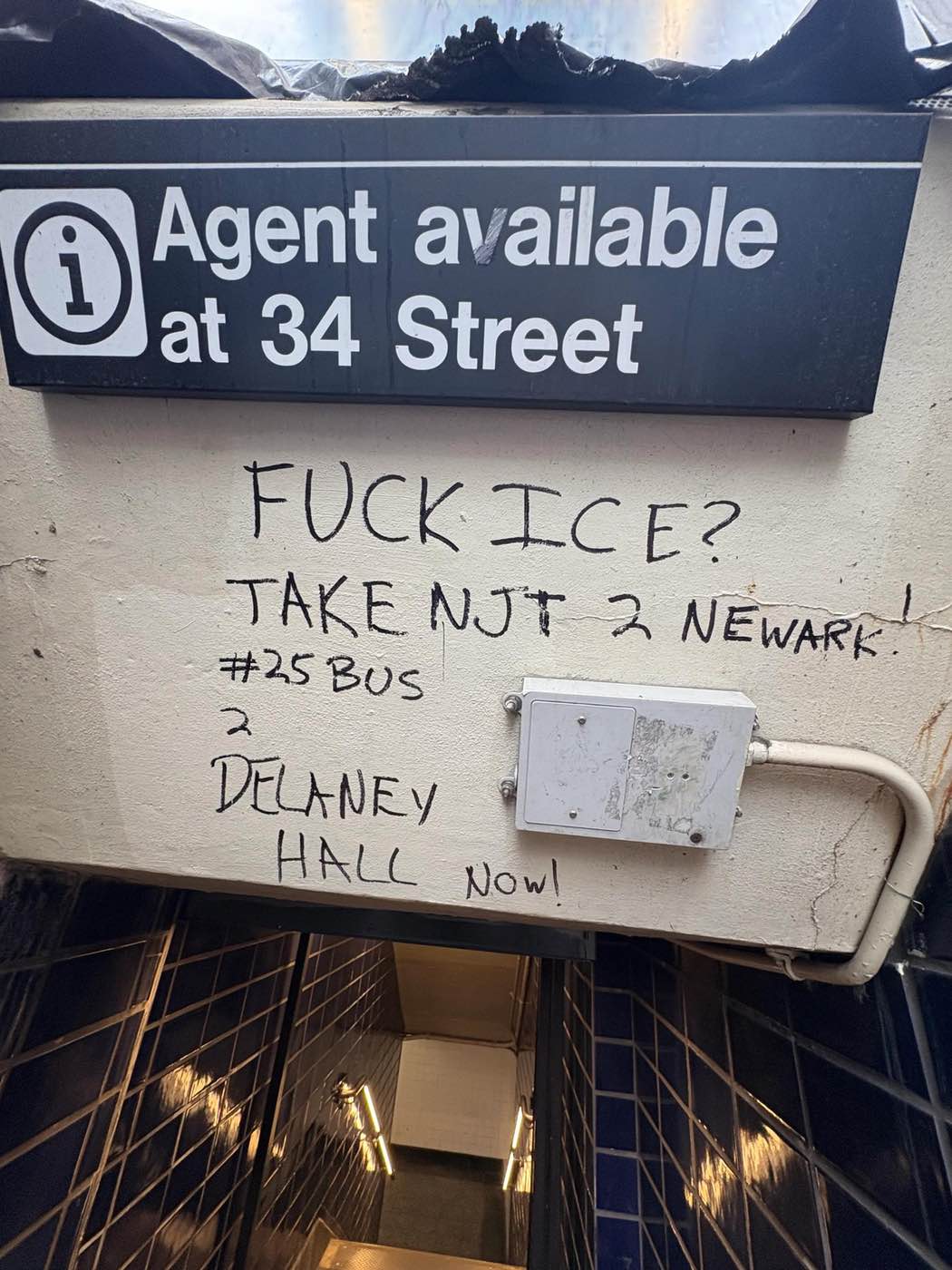
Graffiti directing people in New York City to show up outside Delaney Hall in Newark.
May 25: Memorial Day
The events of the previous night marked the escalation that set the tone for the following week. A continuous presence of volunteers and protesters maintained the vigil throughout that night; the following morning, approximately ten protesters remained outside the gates of Delaney Hall. Governor Mikie Sherrill was due to arrive at 10 am to attempt entry and give a press briefing at the facility. Menendez remained inside the gates, still barred from entry.
At about 7:30 am, a group of ICE agents could be seen staging down Doremus Ave, the road on which Delaney Hall is located. The agents were joined by a BearCat—a police armored personnel carrier. The roughly twenty agents were armed with pepper spray; the agent in the turret of the BearCat sported a FTC PRO pepperball gun.
The agents dispersed the last few protesters and tore down the temporary barriers, lifting them into the dumpster beside the south gate. They then staged in front of the gate, standing across from a slowly growing crowd of protesters and journalists.
Governor Sherrill arrived with more media in tow to cover her press briefing. She unsuccessfully attempted to enter Delaney Hall, then delivered a speech in front of the gates. Her speech frustrated protesters, as she offered few details about how the strikers’ demands might be met. She also misrepresented some details of the demands and the operations of the facility, suggesting that she had only a superficial understanding of the conflict.
The governor departed by 11 am, and tensions between protesters and ICE agents mounted quickly. ICE agents attempted to clear a path through the crowd for a steady stream of transport vehicles. Senator Kim attempted to intervene, negotiating with the ICE agents and the gathering crowd to allow vehicles to pass if he could check them for transfers. Some protesters continued blocking vehicles. For the most part, Kim was denied access to the transport vehicles.
While Kim stood between protesters and the agents, still negotiating, a transport approached from the gates. The crowd pressed forward and the agent on the turret of the BearCat opened fire indiscriminately. Afterwards, Kim reported that he felt the sting of something hitting him in the back, and then a chemical burn in his lungs and eyes. The agents also deployed pepper spray, striking many people, including Kim and several of his staffers, who required eye flushing afterwards.
Kim eventually gained entry to the facility after personally calling the Secretary of the Department of Homeland Security, Markwayn Mullin. This was possible only because of congress is the source of funding for all DHS operations, which secures them legal power of oversight. Afterwards, Kim was able to confirm that Martin Soto had been transferred.
After the melee, the pressure of the crowd diminished as protesters and volunteers regrouped. Throughout the day, reports returned from family that the strikers were being collectively punishment. Most of the strikers were prevented from communicating with anyone outside, including with lawyers or with commissary accounts needed to purchase supplemental food. Some prisoners were forced to stand for extended periods of time, and many were threatened with transfer. Visitation was canceled indefinitely. The strikers reported that they were frustrated that people outside Delaney Hall were focusing on the conditions in the prison, emphasizing their desire for freedom, due process, and the closure of the detention facility.
The agents who had attacked the crowd eventually reentered the facility. The rest of the afternoon and evening passed without incident.
Throughout the afternoon and evening, protesters built a barricade, tearing up cement bricks from a retaining wall between the prison and the sidewalk. They employed additional scrap metal and refuse from the adjacent train tracks to reinforce the barricade.
May 26: The Start of a Three-Day Brawl
Once again, at 7 am, ICE agents reinforced by a BearCat deployed from the south gate. Using pepper spray and batons, they cleared a path through the crowd of about twenty protesters. Confrontations between protesters and ICE agents continued.
By 4 pm, the crowd had grown to about 60 protesters. As the number of protesters grew, more agents appeared, forming a line. They pulled up three vehicles branded with ICE logos. These vehicles are typically not used for regular immigration enforcement operations; they first showed up in Minneapolis during a retaliatory rampage Greg Bovino led on January 13. They staged the vehicles in front of the gates, with the agents shoulder to shoulder on the sidewalk facing the protesters assembled in the street.
As the sun set at 8 pm, the shoving match between agents and protesters settled into a 30-minute rhythm in which agents repeatedly lunged forward across the five feet separating the two lines. First, some agents would deploy pepper spray while others charged forward holding their batons horizontally as a bar at chest height. Once in contact with the arm-locked crowd, they would shove people to the ground, often swinging the batons at people’s knees. Sometimes this push coincided with vehicles leaving or entering the south gate, but often, there were no vehicles coming; it was as if they were adhering to a schedule.
The agents deploying the pepper spray repeatedly sought to pull protesters’ protective masks and goggles away from their faces in order to spray directly into their eyes and mouths. At first, the medics treating those impacted by the pepper spray were baffled by how long the effects lasted and how resistant the spray was to decontamination with soap solution. They eventually concluded that ICE had switched to a pepper-gel formulation, likely to compensate for the persistently windy conditions on Doremus Avenue.
Three individuals were marked for capture in the course of the night, and agents repeatedly broke through the line of protesters in twos or threes to chase them down. ICE agents incapacitated one of these individuals with a taser, and slammed the other two to the ground. All three were carried through the prison gates. One of the detainees was a volunteer with Eyes on ICE, marked with a red cross and explicitly operating as a medic. The agents flashed their flashlights at him repeatedly, and one protester reported hearing a confirmation of location and target from the agents immediately before they attempted to detain him. Eight agents surrounded and tackled the medic about twenty yards outside the conflict line, and carried him face down back to the prison.
Later that evening, all three of the people that ICE had captured that day were left under a bridge about two miles away with all of their possessions. The medic was still marked with his red cross. One of the detainees reported being locked in an unventilated van for almost seven hours with his hands restrained and a possible concussion.
May 27
Clashes continued through the night, with the agents using copious amounts of pepper spray. By morning, when many of the protesters had dispersed, the BearCat returned. During an outdoor recreation period, one of the detainees called out to the protesters: “Libertad, libertad, libertad!” Guards were observed mocking the prisoners and attempting to goad them into a confrontation, threatening them with large canisters of what volunteers suspected to be tear gas.
The detainees who were still able to call their lawyers reported that the labor strike had forced the prison administrators to clean the bathrooms themselves. The strikers were not allowed to leave their rooms, and there were reports of a strong chemical odor emanating from the ventilation pipes. One ambulance left the facility that evening. One of the hunger strikers was released.
Once again, the ICE agents adhered to the 30-minute intervals, repeatedly pushing protesters back, often into heavy traffic. Doremus Avenue serves as an industrial artery, with large cargo trucks comprising much of the traffic. ICE agents repeatedly shoved protesters into the wheels of passing trucks. The agents appeared to be attempting to coordinate their attacks with the passing of traffic.
The agents mostly used their batons as barring tools to secure space while other agents swung the batons at the knees of protesters. In the course of the day, several protesters required transport to the hospital, suffering nerve and bone damage from beatings or vehicle strikes. The same woman who had been the first casualty of Sunday night required a return trip to the hospital. She was unable to walk.
That evening, protesters intensified their defensive strategy, employing shields constructed from traffic cones. More experienced anti-ICE activists from the Twin Cities, Los Angeles, and Chicago arrived to share tactical experience. Activists from Minnesota reported shock at the intensity of violence on display at the gate.
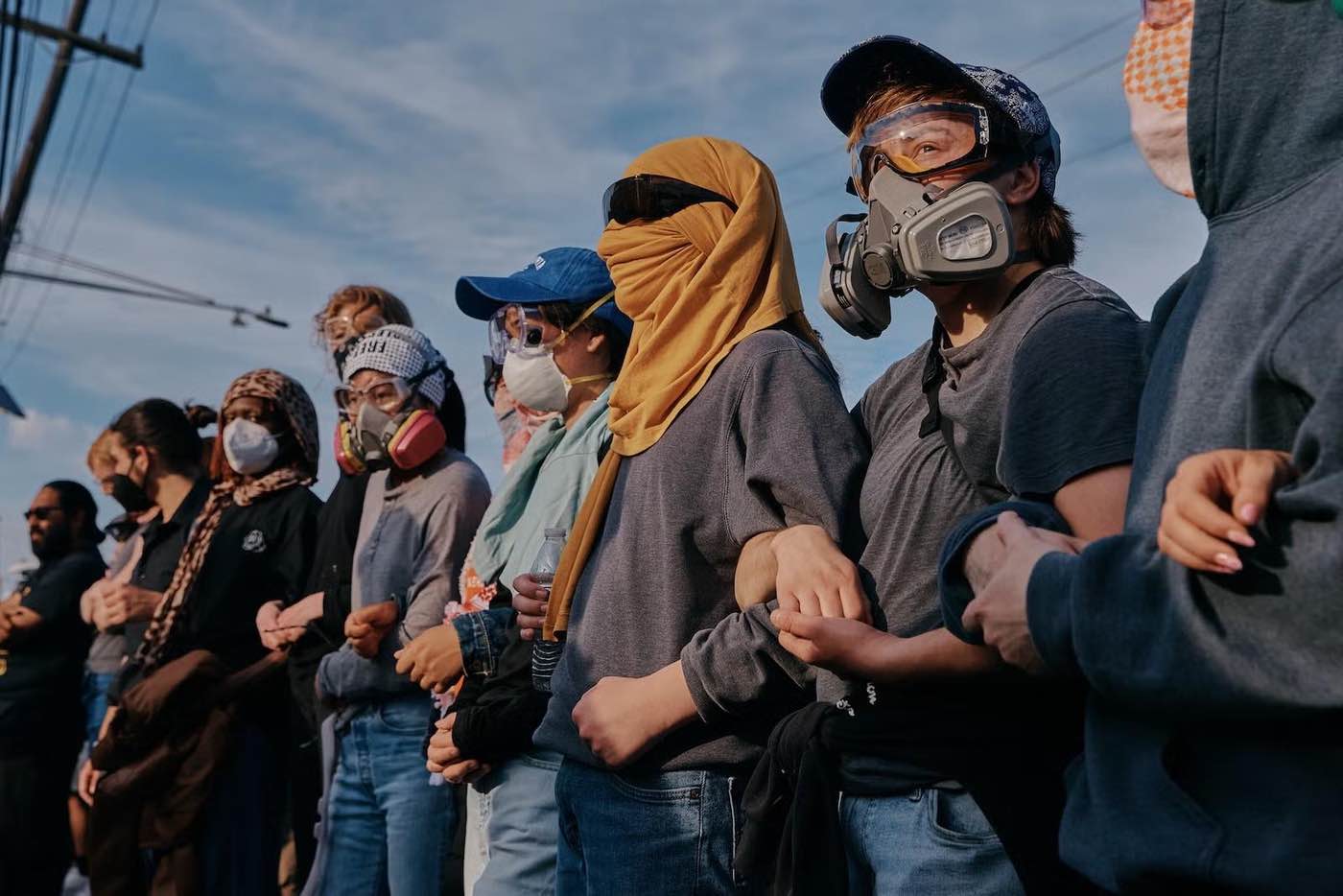
Demonstrators confront ICE agents outside Delaney Hall on Wednesday, May 27.
May 28
Governor Sherrill held a press briefing on the afternoon of Thursday, May 28, announcing a need for DHS to step back from crowd control functions at the gate and declaring that the state police would take their place the following day. She also announced the establishment of a “First Amendment Zone” to “protect” the protesters. During the day, prison officials spray-painted a line marking the boundary of the property of Delaney Hall. In fact, apart from the private property of the prison, the entire sidewalk and street is public property, and should legally require no special demarcation regarding where people’s rights begin and end.
At about 1:30 pm, advocates and family members began receiving calls from detainees relaying that about forty guards from the Corrections Emergency Response Team (CERT) had entered their unit and began beating selected targets among the strikers, with ICE agents joining in.
This retaliation occurred when CERT entered the striking unit 2a/b to remove a detainee who had been translating for the strikers’ communications with advocates outside. The strikers, gathered in a common area between cells, locked arms around that person. The agents and CERT team beat them and deployed CS gas in the hallways to drive the strikers back into their rooms. Then they opened each door in the unit and sprayed a heavy dose of pepper spray into the poorly ventilated rooms. Four ambulances carried away severely injured detainees later that afternoon, and nearly all of those in the striking women’s unit (unit 1) were transferred out of the prison.
The contact between the line of ICE and the line of protesters replicated the established pattern of the previous day, intensifying at sundown, then becoming less frequent in the early morning as the number of protesters dwindled. During the day, the agents used batons less, opting for direct hand-to-hand confrontation. They would grab demonstrators’ clothing or PPE and use it to throw the protester to the ground. The agents appeared to be rotating on a nightly basis; Thursday night’s agents were visibly larger than their predecessors. They bodily lifted smaller protesters in order to throw them at the ground or into oncoming traffic. They continued to use batons, spray, and pepper balls, but to a lesser degree. Once again, a number of protesters were injured and required medical attention.
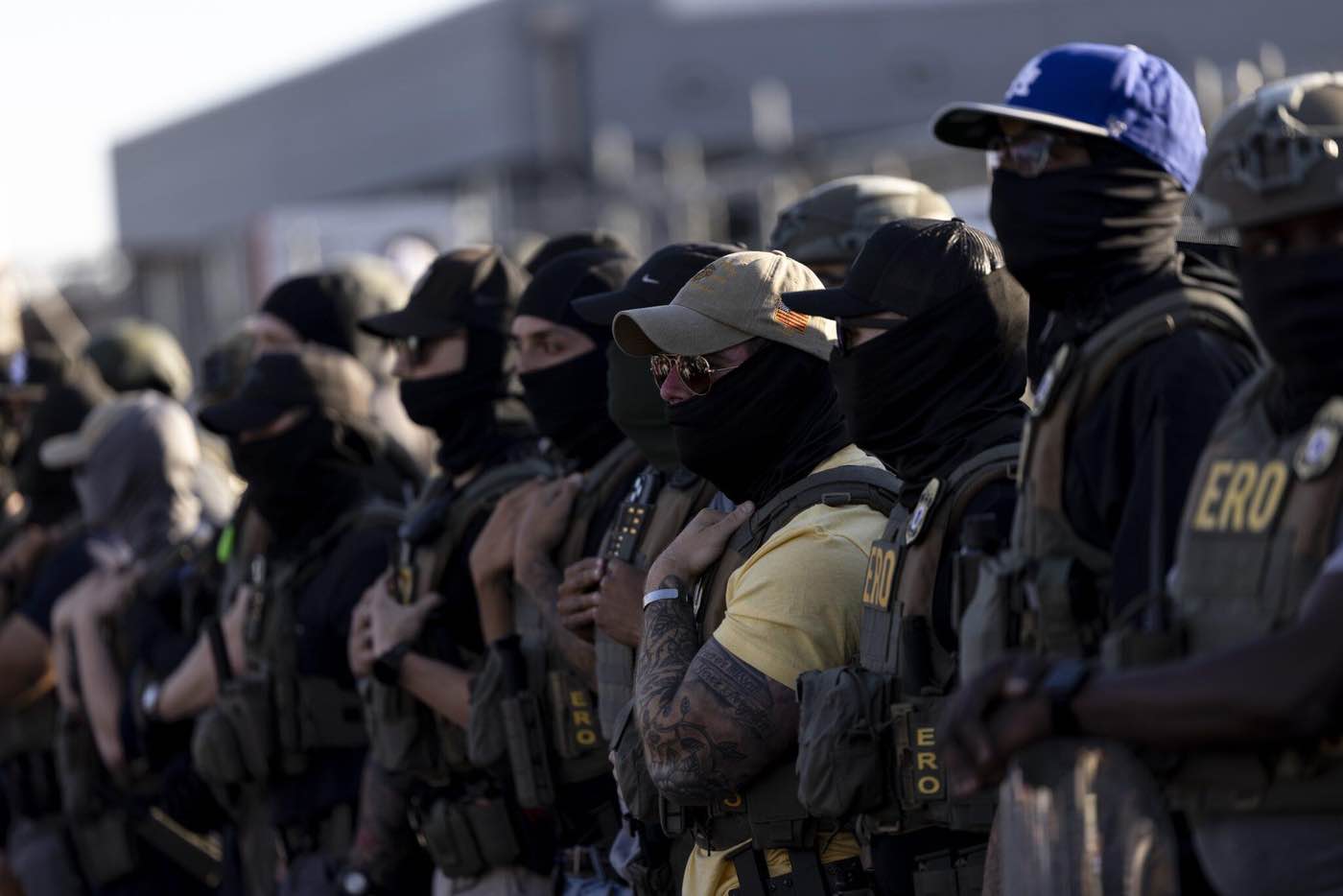
ICE agents prepare to brutalize protesters outside Delaney Hall on Thursday, May 28.
May 29
On Friday, May 29, reports began filtering in that strikers were eating again. The strikers communicated a new demand that outside medical treatment be offered to the members of unit 2a/b who had been beaten.
A number of Facebook groups announced a counter-protest at the prison planned for Saturday at 10 am. Pro-ICE counter-protesters had been appearing in growing numbers throughout the week, though never exceeding a handful. They typically arrived during the day and stood with the ICE agents, antagonizing the protesters.
Newark Police, in coordination with New Jersey State Police, began staging at the two roads intersecting Doremus about a half mile north and south of the prison. They put new barriers in place. The ICE agents were still visibly staged at the mouth of the south gate. An additional line of state and local police formed between the protesters and the ICE agents, facing the protesters. They conducted a few arrests, but much of the day passed without conflict. All non-commercial traffic was blocked from Doremus Avenue, forcing protesters and volunteers to park on the perpendicular roads, Roanoke Avenue and Wilson Avenue.
As 9 pm approached, the crowd of protesters, holding steady at about one hundred people, received warning that they would be subject to arrest if they remained. State Police in riot gear closed off both ends of the street. At about 9:30 pm, a third line of State Police in riot gear appeared 300 yards north of the gathered protesters. The protesters formed their own line, facing north, and waited to see what sort of assault was coming.
Assuming a shield wall formation, the police began shooting mortar-fired tear gas behind the assembled protesters, into the direction that they were ordering the protesters to disperse. The police advanced, attacking the protesters with flash-bang grenades and less-lethal 40 mm foam rounds. Throughout the confrontation, they also used stinger pellet rounds, while ICE agents fired pepper balls from their position on the flank of the retreating protesters. The CS gas was largely ineffective, as the wind was blowing the gas from the south to the north, where the police line was formed. Mounted horse units moved in front of the advancing shield wall and charged the slowly retreating protesters.
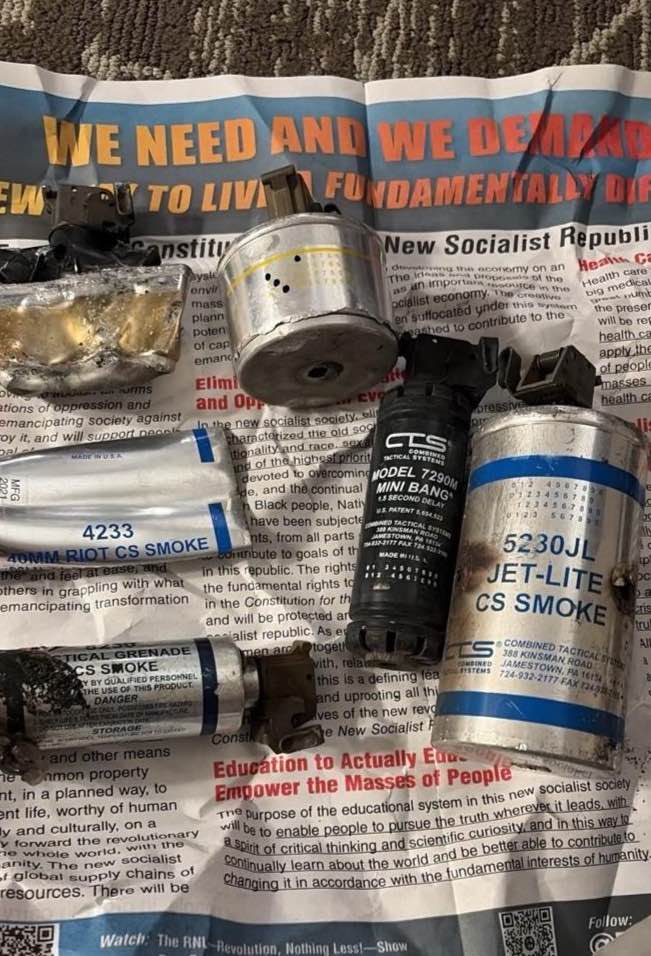
A photo supplied by a protester showing spent munitions that the New Jersey State Police fired at demonstrators on the night of May 29.
State Police fired tear gas directly at independent media journalists, hitting at least one person. Reporters from national media outlets suddenly disappeared into their vehicles and did not film the advance. It is possible they were instructed to do so ahead of time. As the protesters made contact with the shield wall of police, some shoving took place. The protesters eventually dispersed, retreating to their vehicles. Police arrested some of them. It was eventually learned from the police that the goal of the action was to open space for a shift change at the prison.
The New Jersey Attorney General released a statement about the clashes between State Police and the protesters, characterizing the protesters as the instigators. Absurdly, they accused the protesters of attacking the police with tear gas, directly contradicting ample video documentation of what actually happened.
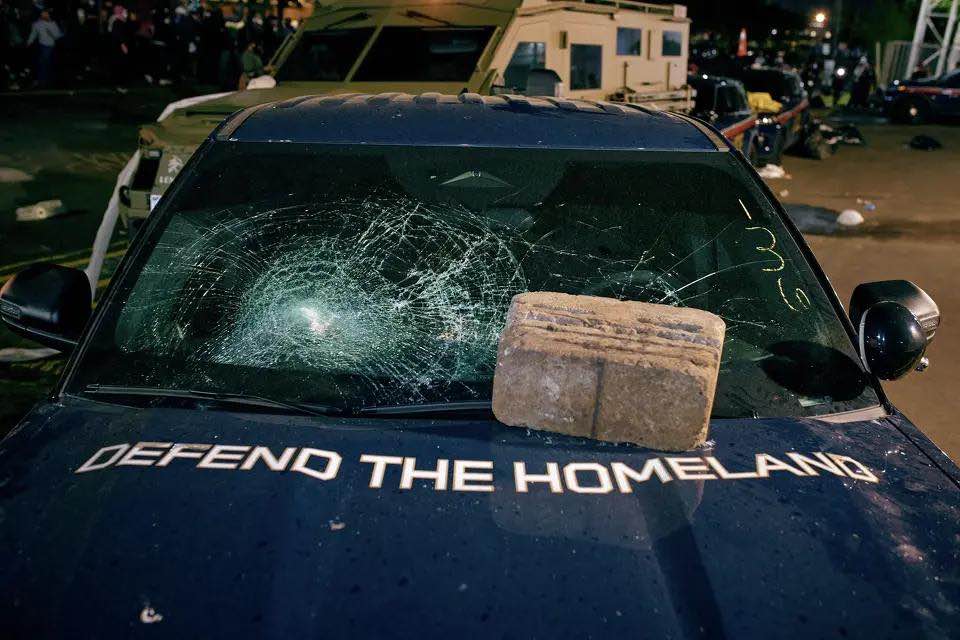
A Department of Homeland Security vehicle damaged during a protest outside Delaney Hall on May 29.
May 30
Newark Mayor Ras Baraka announced a 9 pm curfew, calling for “order” in the streets. Newark Police erected metal corral barriers in front of their line facing the street and created a separation between the designated spaces for protest and counter-protest.
Over two hundred people assembled, despite the ban on parking on the entire street. Several hundred police were present as well, from multiple departments, both local and state.
All this time, the volunteers at the hospitality tent had been organizing to receive people as they were released, as between one and three detainees had been released each day over the preceding three days. Volunteers also continued organizing peaceful protest events including prayer circles, singing, and dancing. Conflicts continued between volunteers and protesters who wanted to block vehicles. Multiple chapters of the Democratic Socialists of America had been called to the protest by the Eyes on ICE volunteers, with the request to train and assist in marshalling the crowd.
At the most, between twenty and thirty individuals participated in the counterprotest. About eight of them claimed to represent the Proud Boys, arriving in shirts and masks branded with their signature logo. One carried a bottle of bear mace. No physical confrontations occurred and they eventually left at about 2 pm.
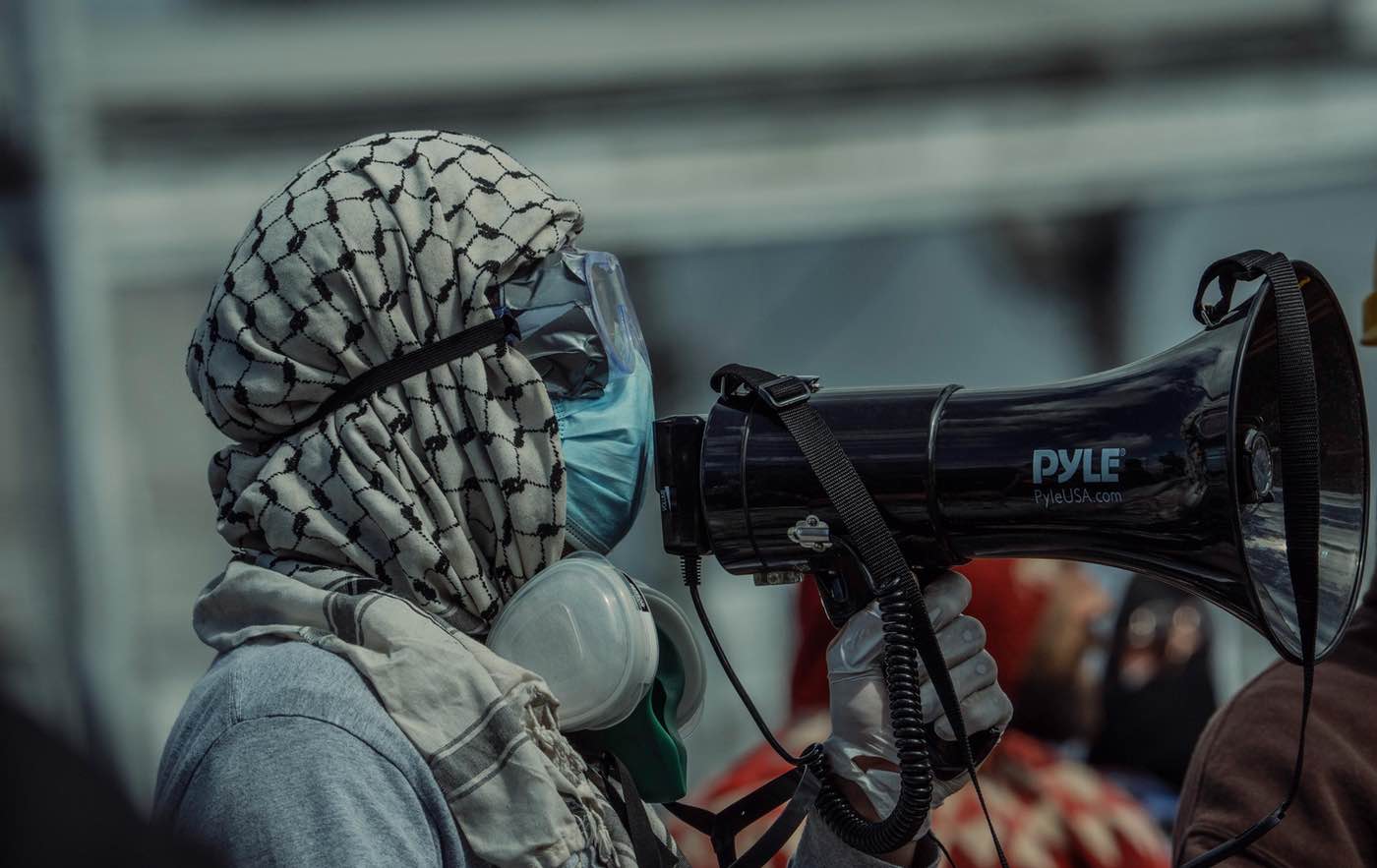
Outside Delaney Hall on the afternoon of Saturday, May 30. Photograph by Fizzy Fox Photographer.
The rest of the day passed without incident until the 9 pm curfew. Once again, the State Police staged to the north; but this time, they deployed the shield wall to the south of the crowd. They advanced on the crowd the same way they had the previous night, firing tear gas over the heads of protesters while throwing gas canisters and flash-bang grenades in front of them. Horse units deployed again, but this time, the protesters were less willing to give ground.
Police pushed the protesters back to the part of the street directly in front of the south gate. At that point, Newark Police were attempting to hold the barrier fences between the police line and the street, perpendicular to the advancing shield wall. None of the local police were equipped with PPE; they began choking and covering their faces with their uniforms as clouds of gas wafted into their line. Protesters grabbed the dividing fence and pulled it away from the police, repurposing it as a barrier between themselves and the advancing shield wall. The Newark Police retreated into the prison gates.
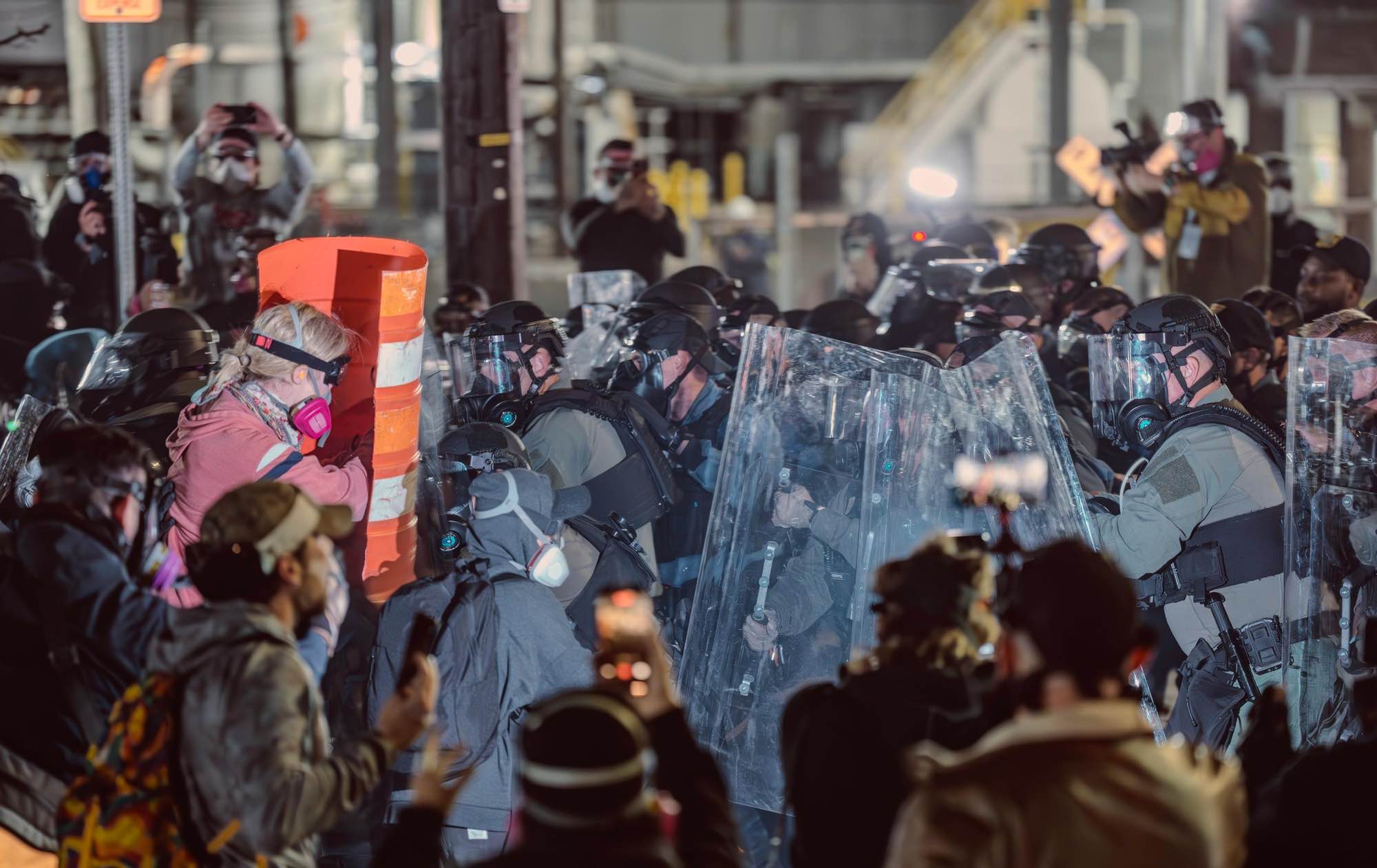
This time, protesters clashed more directly with the State Police, pushing back with makeshift shields and holding on to the barriers that they had pulled away from the local police. The police used same crowd control weapons again, eventually forcing the crowd of people north toward Roanoke Avenue. They made about a dozen arrests as the crowd retreated and inflicted severe injuries on several protesters, primarily by means of rubber bullets and other less-lethal rounds but also by slamming their shields into protesters.
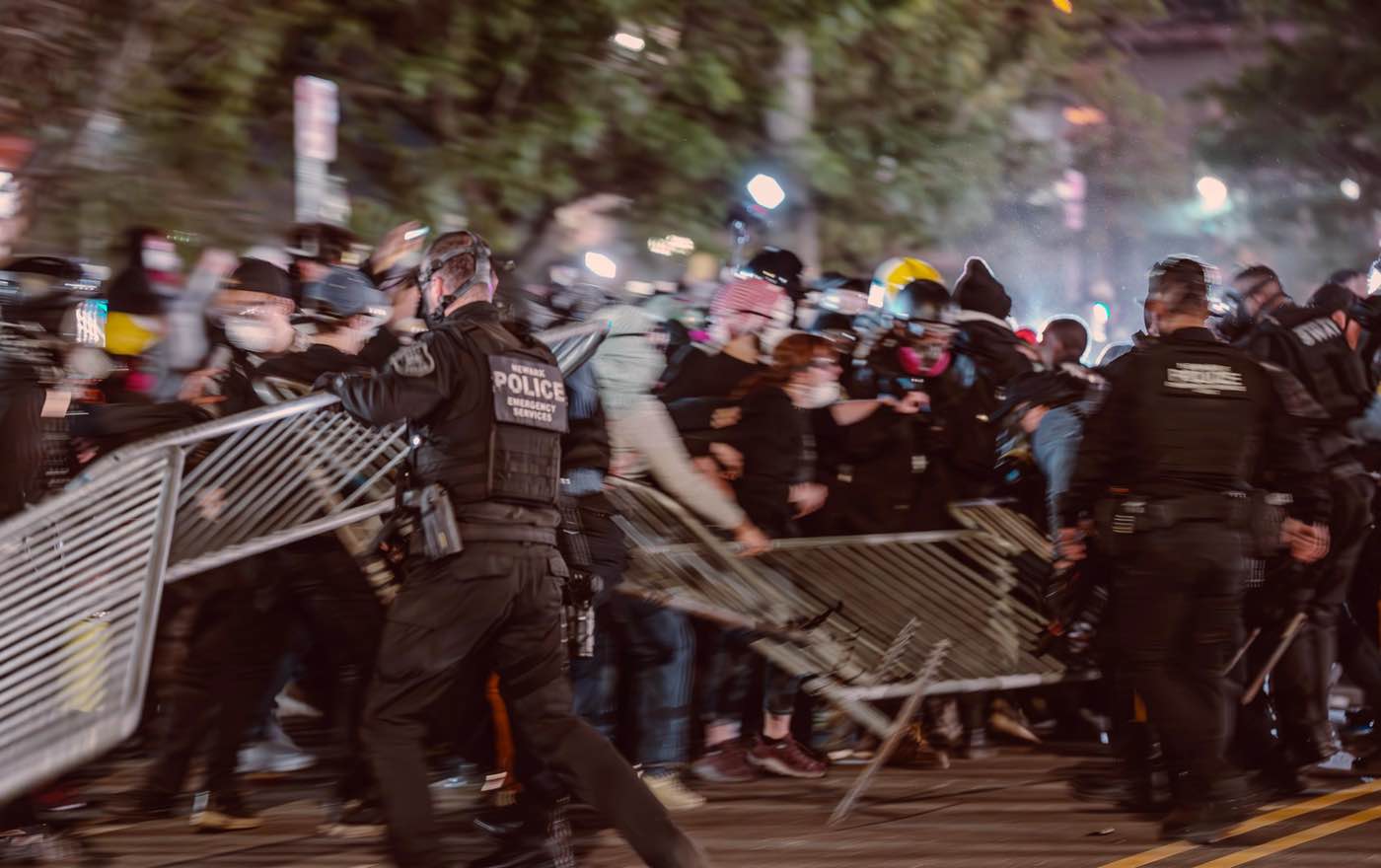
A confrontation outside Delaney Hall on the evening of Saturday, May 30. Photograph by Fizzy Fox Photographer.
As the line of conflict moved past the hospitality tent, the police targeted several volunteers with Eyes on ICE and its affiliated aid organizations for arrest.
The protesters slowly backed down Doremus until they reached the intersection of Roanoke and Doremus, where a second shield wall of riot police was waiting. The police stopped there and faced the remaining protesters for almost half an hour while the protesters led chants and gave speeches. Someone started a fire using the tires and debris scattered over the road. The protesters chanted “When the streets get hot, ICE MELTS! When the streets burn, ICE MELTS!” as they prepared for what appeared to be a kettling action.
The confrontation fizzled when a person in a wheelchair, accompanied by someone pushing it, approached the police line and began asking to be let through. Both people identified themselves as press; one was an Associated Press photographer and the other, a New York Times reporter. Both were displaying press credentials on lanyards. The person in the wheelchair informed the police that their knee was broken and they needed to pass the shield wall to reach immediate medical attention. The police were silent.
This encounter lasted for ten minutes, with the protesters offering to back up to convince the police to open a passage for the injured person. With no audible instructions from the police, the journalists continued to plead; eventually, the police opened a small hole in their line. The injured person asked several times if it was safe to approach; the police gave no discernible answer. Eventually, without instruction from the police, the two passed through the opening. Police issued warnings to the remaining protesters, arresting and charging a few of them.
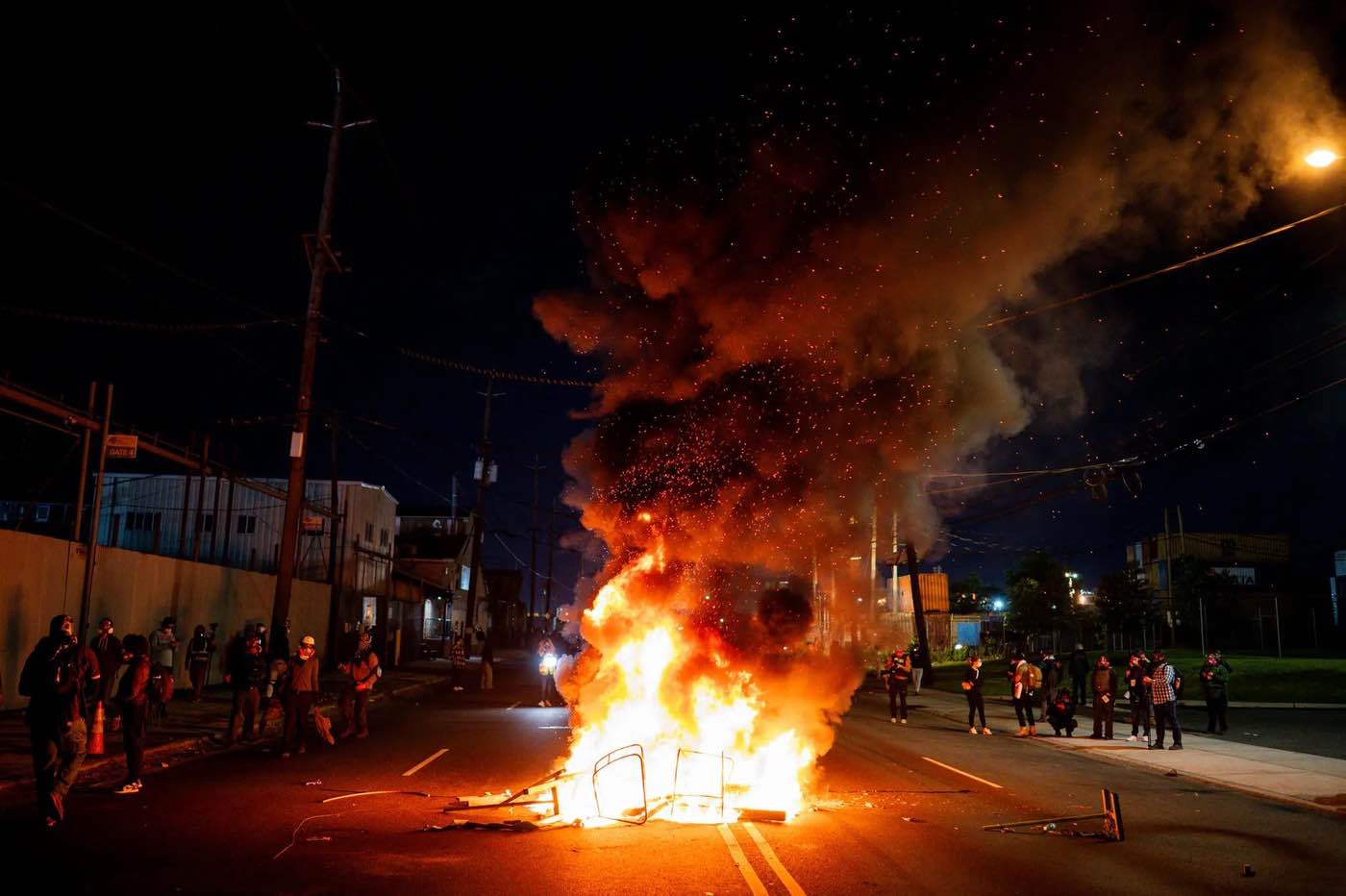
A fire down the street from Delaney Hall on the evening of Saturday, May 30.
May 31: The Kettle
Far fewer protesters arrived on Sunday, May 31. The entire street was closed to nonessential traffic. Those who did show up stood at the intersections with Roanoke to the north or Wilson to the south. For the first time, police did not let in volunteers to receive released detainees.
At midday, Governor Sherrill held a press briefing, announcing a coordinated effort to cooperate with local police to take over and eventually close Delaney Hall through legal means.
As the curfew approached, between fifty and sixty protesters gathered at the intersection of Wilson and Doremus, facing the State Police at the new roadblock. Some protesters pleaded with the police to reconsider their actions, informing them that the protesters were unarmed and holding their hands up to demonstrate this. At one point, people on foot who had traveled to Doremus to visit friends in the Essex County Corrections Facility walked into the middle of the standoff and, not knowing what exactly was going on, joined the protesters. They down sat in front of the protesters, who gave them helmets to protect them from less lethal munitions.
All of the medics departed, pleading with the protesters to do the same, arguing that they had sustained too many injuries and arrests to remain in danger.
At about 10 pm, the police began firing rubber bullets sporadically. Officers could be seen coordinating to target specific protesters. Some protesters began singing, “All that we are saying is give peace a chance,” hands raised in the air. Police received the order to advance and began rushing toward the protesters, shooting rubber bullets and flash-bang grenades. The protesters turned and ran.
Synchronizing their movements, the police encircled the retreating crowd with a shield line. They formed a half circle around the protesters, backing them up against a wall. For ten minutes, they periodically picked off protesters at the edge of the kettle. Four police officers seized one of the people who had happened upon the protest while on their way to visit the Essex facility, dragging him into the wall of shields in a seated position. The wall of police closed around him, concealing the officers as they beat and pepper-sprayed him.
The police closed in three steps in unison. Then they announced that individuals with “verified” press credentials would be allowed to leave. An officer checked press passes as at least ten independent journalists left the kettle.
After pushing the journalists to a distance of over a hundred yards away, the police mass-arrested the remaining detainees. They made a total of sixty-four known arrests that night, including mutual aid volunteers. All the arrestees were held overnight and released with court summonses after twenty hours in custody. Most of the charges were “disorderly persons” and resisting arrest.
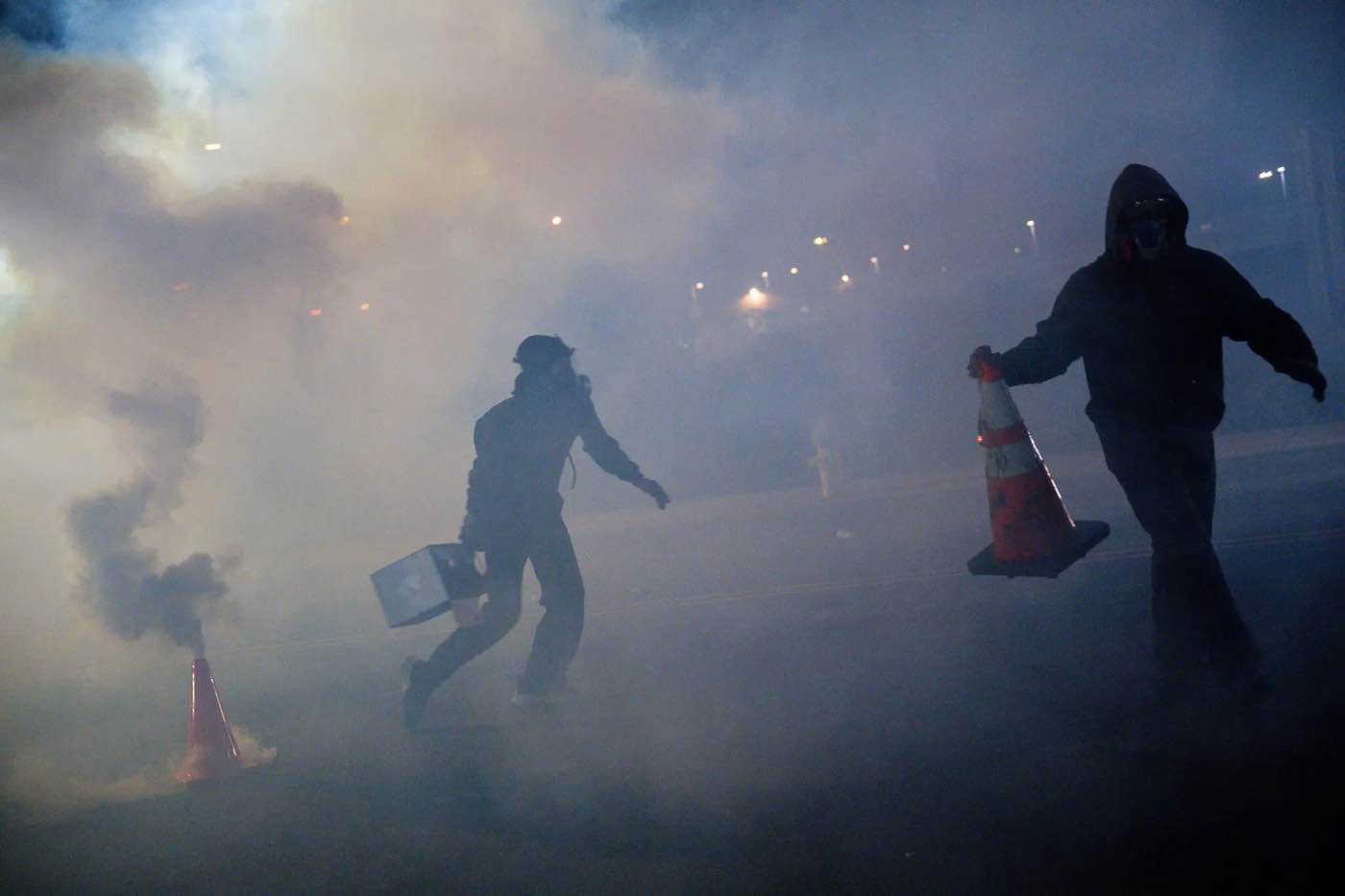
Demonstrators use traffic cones to attempt to extinguish tear gas canisters on the night of May 30. We recommend immersing canisters in water to extinguish them; you can learn about how to do so safely here.
Aftermath
The next day, Mayor Baraka announced that he would not be participating in cooperation with the State Police or ICE. He cited the misuse of police force, claiming that it was putting Newark’s own officers in danger.
Governor Sherrill also made an announcement, presenting a plan to close Delaney Hall by bringing a lawsuit against GEO Group for illegally barring state inspectors from accessing the facilities’ medical units, bathrooms, and sleeping areas. She characterized the Eyes on ICE volunteers who had been rendering mutual aid and legal assistance to detainees and their families as “peaceful protesters, there for the past year,” implying that the Radical Hospitality Tent was some sort of state-sanctioned, palatable protest center. This is how her remarks were reported on outlets like Fox News. She also announced that she would be handing management of the street over to the Newark Police and withdrawing most of the State Police.
On Monday, as a limited number of Eyes on ICE volunteers were allowed back to the tent, they discovered investigative units from the Federal Bureau of Investigation and Homeland Security Investigations inside, ransacking it. The agents had overturned everything inside the tent; many items were missing including diapers, an electric cooler, announcements of prayer gatherings posted on a bulletin board, and personal possessions.
The hospitality tent still stands, though it will take professional cleaning crews to decontaminate it of CS gas residue. The volunteers are exhausted, but those who were arrested have been released, albeit with charges. Eyes on ICE continues working to ensure some degree of independent monitoring at the detention facility as well as supporting detainees and their families.
New Jersey is still reeling from the week of vicious retaliation for the strike from both the state and federal governments. Narratives about the protests are regularly misrepresented in corporate news outlets. Nonetheless, centrists who were mostly sympathetic to the volunteers before this week have experienced collective disillusionment with state authority, especially with their Democratic governor, Mikie Sherrill.
It remains to be seen whether conditions will improve for the detainees in Delaney Hall. Yet their story has been elevated to a national audience, forcing another discussion about police violence and immigration enforcement. For now, ICE continues to operate from their field office in downtown Newark at 614 Frelinghuysen Avenue.
An increasing number of people have been released from the facility, including some who managed to obtain the attention of congresspeople on oversight visits. Many of those released have expressed profound gratitude for the nationwide expressions of solidarity, and the solidarity of the protesters, which they could hear from within their cells. The strike at Delaney Hall has sparked strikes in other facilities around the country.
Visitation is set to resume soon with new restrictions. The people who stand at the gates of Delaney Hall, day in and day out, will continue to stand there. Many will continue working to dismantle the unjust immigration system, as they did before the opening of Delaney Hall.
Anti-ICE protesters will regroup and converge on the next flashpoint, wherever that may be. Their numbers will likely be bolstered by new companions from New York and New Jersey, who will add their recent experience defying ICE to the movement’s collective memory. The fight will continue as they refine their tactics and strategies.
Further Reading
- “To Demand Freedom”: The Hunger Strike at Delaney Hall Detention Center
- A Demonstrator’s Guide to Understanding Riot Munitions—And How to Defend against Them